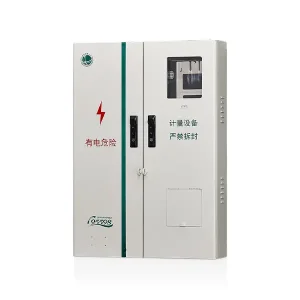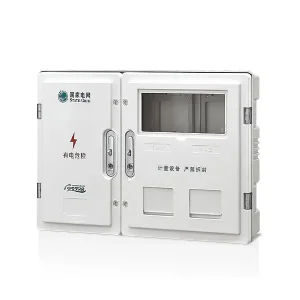
Wholesale China TY-SXD2-A Single-Phase Electric Energy Metering Box | Reliable Suppliers & Factory Solutions
View Product Specs
Precision-manufactured in Yueqing, Zhejiang—the Electrical Capital of China. Our factory delivers IEC-compliant, impact-resistant, and weather-hardened single-phase, three-phase, and solar grid-tie metering cabinets for global utility operators.
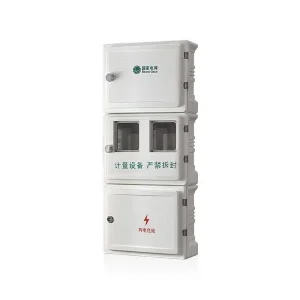
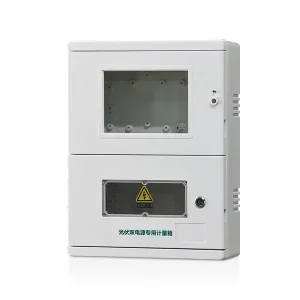
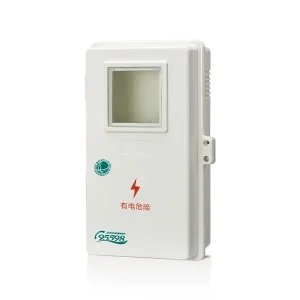
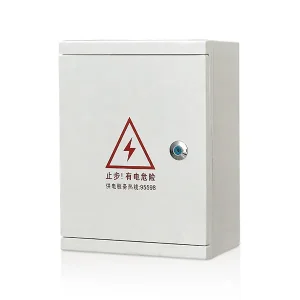
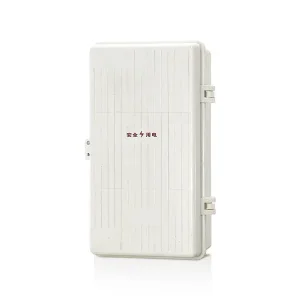
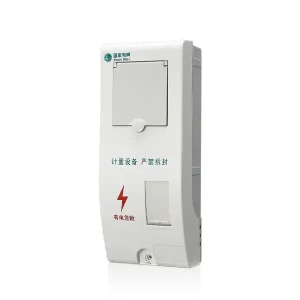
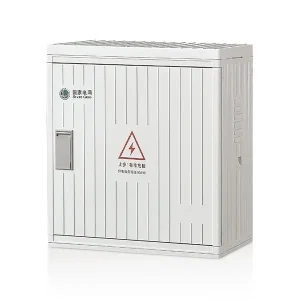
As municipal grids undergo digital transformation toward Advanced Metering Infrastructure (AMI) and Smart Gas telemetry, the demand for highly resilient, tamper-proof, and weatherized enclosures has expanded dramatically. Modern utility asset managers no longer procure enclosures merely as passive plastic or metal covers; they treat them as critical protective nodes guarding revenue integrity, life-safety shutoff mechanisms, and wireless IoT data nodes.
The transition from sheet metal to Sheet Molding Compound (SMC unsaturated polyester GRP) eliminates catastrophic rust and grounding hazards. Formulated with high-strength roving fibers and flame-retardant resins, our boxes achieve UL94-V0 flammability and complete electrical isolation without requiring protective earthing conductors.
Unmetered consumption and physical tampering account for billions in global utility losses. Leading Chinese factories integrate structural anti-tampering: concealed hinges, multi-point internal latches, tamper-evident RFID sealing points, and isolated utility/consumer partition barriers that eliminate unauthorized bypasses.
RF-transparent SMC composite structures permit seamless wireless transmission for LoRaWAN, NB-IoT, and GPRS smart gas/electricity meters without requiring external antenna penetrations. This prevents moisture ingress points and protects signal integrity in dense urban masonry installations.
China’s electrical manufacturing epicenter in Yueqing, Wenzhou provides an unmatched combination of rapid tooling turnaround, full vertical supply-chain integration, and deep compliance with international utility standards.
Within a 15-kilometer radius in Yueqing, our factory sources raw resin compounds, specialized E-glass roving, silver-plated copper busbars, and miniature circuit breakers (MCBs), reducing assembly lead times from months to weeks.
Equipped with computerized high-tonnage hydraulic compression presses (ranging from 300T to 2000T), our plants achieve uniform density, smooth anti-dust finishes, and structural wall consistency impossible with hand lay-up GRP.
CNC precision steel mold manufacturing in Zhejiang costs up to 65% less than in Western Europe or North America, enabling utilities to commission proprietary customized metering enclosures with low initial capital expense.
Our agile engineering workflow moves from 3D CAD modeling and finite element stress analysis (FEA) to functional physical sampling within 10 to 15 days, securing tender readiness for international turnkey EPC contractors.
The worldwide modernization of energy and gas distribution is prompting new performance benchmarks. From decentralized rooftop solar generation to hazardous-zone gas venting, China's forward-thinking manufacturers are incorporating smart features directly into enclosure architecture.
Urban multi-utility modernization favors integrated utility service niches. Chinese manufacturers now engineer compartmentalized dual-service enclosures featuring explosion-proof gas barriers, labyrinth passive ventilation louvers, and spark-isolated electric meter bays in compliance with ATEX/IECEx spatial separation codes.
Distributed rooftop solar requires metering enclosures that accommodate bidirectional meters, micro-inverter disconnect switches, surge protective devices (SPD Type II), and DC/AC isolation barriers. Enclosures must withstand high internal operating temperatures induced by continuous full-load inverter export.
Severe day-night thermal swings in desert and tropical climates create internal condensation that damages metering electronics. Advanced SMC enclosures now feature integrated PTFE breathable membranes (IP66 venting plugs) that equalize pressure while preventing water and dust entry.
When specifying electric and gas meter enclosures, utility engineers must balance mechanical impact resistance, dielectric insulation, thermal stability, and 30-year lifecycle operating expenses.
| Evaluation Parameter | SMC Fiberglass (Compression Molded) | Stainless Steel (304 / 316 Grade) | Polycarbonate (PC / ABS Blend) | Cold-Rolled Sheet Metal (Painted) |
|---|---|---|---|---|
| Dielectric Strength & Safety | Class II Insulation (No grounding needed) | Conductive (Rigid earthing bonding mandatory) | Insulating (Safe touch voltage) | Conductive (Risk of flashover on earthing failure) |
| Salt Fog & Chemical Resistance | Immune to rust, acids, alkalis (Exceeds 1000h salt spray) | High resistance (316 grade required for marine) | Moderate (Prone to chemical stress cracking) | Poor (Blisters & corrodes at cut edges/scratches) |
| Mechanical Impact Resistance | IK10 (Up to 20 Joules impact rating) | IK10+ (Extremely rugged, dent prone) | IK08 - IK09 (Embrittles under low temp) | IK09 (Dents easily, degrading weather seals) |
| UV Aging & Outdoor Life | 30+ Years outdoors with UV stabilizers | 40+ Years (Zero UV degradation) | 8 - 12 Years (Discolors and turns brittle) | 5 - 10 Years (Requires cyclic repainting) |
| RF Permeability for Smart Grid | 100% Transparent (Optimal for IoT/AMI antennas) | 0% Shielded (Requires external drilled antenna) | 100% Transparent | 0% Shielded (Creates Faraday cage) |
| Flammability & Glow Wire | UL94-V0 / GWFI 960°C (Self-extinguishing) | Non-combustible | UL94-V2 to V0 / GWFI 850°C | Non-combustible (Coating can burn) |
| Scrap & Theft Motivation | Zero Scrap Resale Value (Eliminates vandal theft) | High Resale Value (Frequent target for theft) | Zero Resale Value | Moderate Scrap Resale Value |
Different municipal and industrial topographies exert varied environmental stresses on metering infrastructure. Our Yueqing factories engineer specialized configurations tuned to regional microclimates and power architectures.
Salt spray, high relative humidity (above 95%), and wind-driven rain accelerate electrochemical corrosion in metallic meter boxes within 24 months. Our coastal SMC multi-position meter enclosures utilize marine-grade 316 stainless steel hinges, EPDM continuous foaming sealing gaskets, and IP66 ingress protection to deliver a maintenance-free 30-year lifecycle in severe maritime environments.
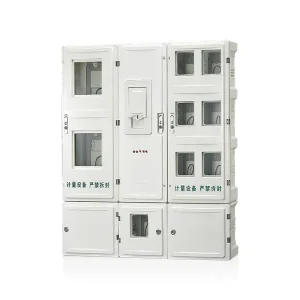
High-rise residential developments require consolidated metering banks that fit compact electrical riser shafts. Our modular TY-SXD2 and TY-SXS multi-meter units feature dedicated customer compartments with transparent polycarbonate observation windows, completely segregated from the locked busbar and utility-only main disconnect switches.
Outdoor gas metering requires unique explosion-prevention considerations. If gas leaks from a diaphragm or ultrasonic meter union, dangerous concentrations must not accumulate inside the cabinet. Our gas meter boxes incorporate top and bottom louvered cross-ventilation, antistatic composite formulations (surface resistivity < 10^9 Ω), and spark-free brass mechanical latching.
Navigating international factory selection requires verifying test documentation, quality systems, and mold engineering capabilities to ensure uninterrupted supply during multi-year utility contracts.
Ensure the manufacturer provides full third-party type test reports from accredited laboratories (such as KEMA, ASTA, TÜV, or CNAS). Essential certificates include IEC 61439-1/-2 for low-voltage switchgear assemblies, IEC 60529 (IP rating verification), and IEC 62262 (IK impact rating).
Examine the supplier's raw material testing protocols. Premium factories measure glass fiber percentage, resin-to-filler ratios, paste viscosity, and gel time for every incoming batch of sheet molding compound to ensure consistent mechanical wall integrity.
Factory Acceptance Testing (FAT) must incorporate routine dielectric withstand testing (2500V/1 min), clearance/creepage distance verifications, gasket compression recovery audits, and mechanical drop tests for hinges and locking points.
Reliable tier-1 Chinese manufacturers serialize every production enclosure via permanent laser etching or in-mold barcode marking, tracking resin batch, molding shift, operator ID, and final inspection sign-off for comprehensive lifecycle accountability.
Inspect tool steel grades (P20 or 718H preferred) and chromium plating thickness on internal mold cavities. High-standard compression molds prevent surface fiber bloom, maintain strict tolerance on door-to-frame seals, and eliminate draft-angle distortion.
Enclosure bulkiness makes container loading optimization crucial. Evaluate whether the factory employs heavy-duty corrugated cartons with foam corners, moisture desiccants, and heat-treated wooden pallets wrapped with automated stretch-film.
Direct technical answers addressing tender requirements, safety certifications, material properties, and manufacturing lead times.
GRP (Glass Reinforced Polyester) is the broad category for all glass-fiber composites. SMC (Sheet Molding Compound) consists of long chopped strands (>25mm) pressed into flat sheets with polyester resin, providing superior mechanical strength and impact resistance for large structural boxes. DMC (Dough Molding Compound, or BMC) uses shorter fibers (6-12mm) in a bulk putty form, commonly used for smaller, intricate interior electrical components.
Premature fiber blooming (where glass strands become exposed on the surface) is prevented by blending high-grade hindered amine light stabilizers (HALS), benzotriazole UV absorbers, and an in-mold resin-rich surface layer during high-pressure thermal compression. This guarantees color stability and surface gloss over 30 years in high-solar-irradiance zones.
Yes. For hazardous gas environments, our factory supplies an antistatic SMC formulation blended with conductive carbon nanotubes or micro-carbon fiber additives. This reduces surface resistivity to between 10^5 and 10^9 Ω, safely dissipating static charge buildup to earth without generating ignition sparks.
Yes. We offer both custom CNC secondary machining (milling, slotting, cable gland punching) on standard enclosure shells and fully customized interchangeable mold inserts. This allows utilities to tailor viewing windows, optical probe ports, and DIN rail fixing studs to their exact meter dimensions without paying for entirely new mold bases.
Tooling for new compression molds generally requires 25 to 35 calendar days from final 3D CAD approval to the first off-tool sample (T1). Standard catalog models carry a low minimum order quantity (MOQ) of 100 to 300 units, while bespoke customized molds generally require an initial commitment of 500 units, with mold fee rebates applied upon reaching agreed annual volumes.
Our three-phase commercial meter enclosures (TY-SXS series) undergo rigorous testing up to a short-time withstand current of 30 kA (Icw for 1 second) and peak withstand currents up to 63 kA. The high mechanical tensile and flexural strength of SMC composite prevents structural bursting, door deflection, or fire propagation during internal arc faults.
Expand network capacity with our factory-engineered cable distribution enclosures, high-volume collector boxes, and stainless steel current transformer (CT) metering units.