
China’s SMC fiberglass box market includes manufacturers serving utility, telecom, transport, and industrial projects. This guide introduces ten Chinese suppliers and the capabilities buyers may want to compare. The Smc Fiberglass Box Series can include meter boxes, junction enclosures, and cabinets for outdoor equipment. Designs vary in size, wall thickness, fittings, and installation needs.
A ranked list is useful, but it is not proof of quality. Buyers should check product drawings, material specifications, sample workmanship, and relevant test reports. Look closely at hinges, seals, mounting points, and cable openings. Small details matter. Ask how a supplier manages production consistency and handles custom dimensions. These questions can reveal more than a polished catalog.
An illustrative expert voice, Lin Wei, is used here as an editorial persona; the quotation is original, not a verified published statement: “A dependable enclosure is judged at its weakest joint, not by its smoothest surface.” That is a practical reminder, not a substitute for independent testing. This overview aims to help readers compare manufacturers carefully, identify useful questions, and avoid treating marketing claims as confirmed performance. Some supplier information may change, so verify current product details directly before making a decision.
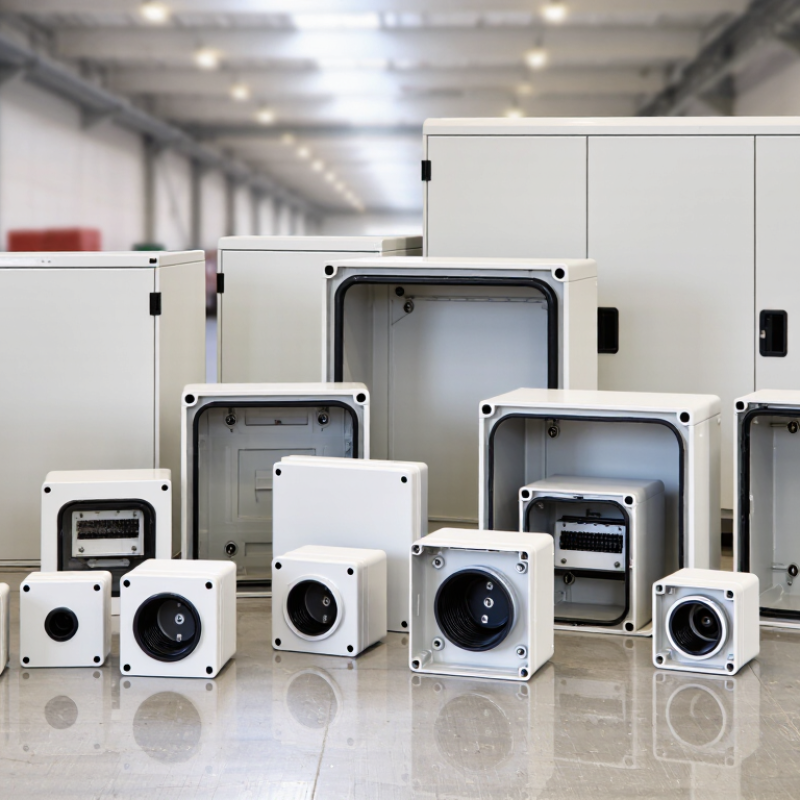
An SMC fiberglass box is an electrical enclosure molded from sheet molding compound, a mixture of glass fibers, resin, and mineral fillers. Heat and pressure shape this compound in a matched mold. The glass fibers reinforce the structure, while the cured resin binds the material into a rigid shell. The result is a lightweight enclosure that can resist corrosion and provide electrical insulation. Not metal.
SMC box series are often offered in several sizes, with options for mounting points, door styles, and cable entries. These details matter on site: a technician may need to fit a gland through a side wall or reach terminals without removing the whole enclosure. Molded surfaces can also reduce sharp edges and simplify cleaning.
Some formulations offer improved UV or flame resistance, but performance depends on the material grade and product design. Fiberglass is not automatically weatherproof. Buyers should check the stated ingress rating, wall thickness, hinge strength, and gasket fit for the intended environment.
A quick visual check helps, though it cannot replace verified test data. Small flaws matter. A warped door or uneven seal can let moisture in, even when the enclosure body looks robust.
China’s SMC fiberglass boxes begin with sheet moulding compound: glass fiber, thermosetting resin, mineral filler, and additives. Fiber distribution matters. Poorly dispersed strands can leave weak corners or visible surface marks.
Plastics Europe’s Plastics—The Fast Facts 2024 reports global plastics production of 413.8 million tonnes in 2023. That figure covers plastics broadly, not SMC alone, but it shows the scale of the material supply chain behind enclosure production.
Design starts with the installation environment. Engineers consider wall thickness, rib placement, gasket channels, hinges, and cable-entry points. A box may look sturdy yet flex around an unevenly tightened screw. That detail is easy to overlook.
During compression moulding, measured charges are placed in a heated metal mould and pressed into shape. Temperature, pressure, and cure time influence surface quality and dimensional consistency. Manufacturers can inspect thickness, fit, and impact performance, then adjust the mould or process when results vary.
There is no perfect shortcut.
A lighter design saves material, but may sacrifice stiffness; thicker walls add weight and may not fix a poorly supported lid. Good process records help connect each defect to a specific moulding condition.
Evaluating Chinese SMC fiberglass box manufacturers starts with the finished enclosure, not the brochure. The IEA’s Electricity 2025 report says global electricity demand rose 4.3% in 2024, increasing pressure on distribution networks and their protective equipment. Ask suppliers for traceable test records covering mechanical strength, water and dust ingress, UV exposure, and temperature cycling. Check whether ratings were tested on the complete box, including its door, gasket, and cable entries. IEC 60529 defines IP protection classifications, but a printed IP rating alone is not proof of consistent production. Small details matter.
Inspect samples closely. A door should close evenly, with continuous gasket contact and no sharp fiberglass edges. Compare wall thickness at corners, hinge movement, latch alignment, and dimensions across multiple units. Request batch records and material specifications, then verify that production samples match the tested design. Ask how the manufacturer controls resin content, curing, and dimensional variation; vague answers deserve follow-up. ISO 9001 certification can indicate a quality-management system, but it does not guarantee product performance. Factory audits and independent test reports provide stronger evidence. I would also ask for a clear explanation of limitations, because outdoor service conditions vary, and no single test reproduces every site.
| China Top 10 SMC Fiberglass Box Series Manufacturers? - Criteria for Evaluating Chinese SMC Box Manufacturers | ||||
|---|---|---|---|---|
| Evaluation Criterion | Suggested Weight | What to Evaluate | Evidence to Request | Evaluation Guidance |
| SMC Material and Formulation | 12% | Confirm the enclosure is made from sheet molding compound and review the specified resin system, reinforcement, and material grade. | Material data sheet, grade identification, and batch traceability records. | Compare documented material properties with the project specification; do not rely on a generic “fiberglass” description alone. |
| Weathering and UV Resistance | 12% | Assess suitability for the intended outdoor exposure, including UV, moisture, and temperature conditions. | Relevant weathering test reports, test method, exposure conditions, and before-and-after inspection results. | Check that test conditions and reported outcomes are applicable to the expected service environment. |
| Mechanical Strength and Impact Performance | 12% | Review resistance to loads and impacts relevant to installation, handling, and use. | Product-level test reports or material test data. ASTM D638, D790, and D256 are examples of plastics test methods for tensile, flexural, and impact properties, respectively. | Distinguish material coupon results from tests performed on the complete enclosure. |
| Ingress Protection (IP) Rating | 12% | Verify the claimed protection against access, solid objects, and water under the conditions specified for the product. | Test report identifying the enclosure configuration and the applicable edition of IEC 60529. | Confirm that doors, seals, fasteners, and cable-entry arrangements in the tested configuration match the supplied product. |
| Electrical Enclosure Standards and Safety | 12% | Check whether the product and its intended application are covered by the relevant enclosure requirements. | Applicable declarations, test reports, and certification scope. IEC 62208 covers empty enclosures for low-voltage switchgear and controlgear assemblies. | Verify the exact model, size, and configuration in the documentation; a standard reference alone does not establish certification. |
| Corrosion and Chemical Resistance | 10% | Assess compatibility with the actual installation atmosphere, cleaning agents, and chemicals the enclosure may contact. | Chemical compatibility information and test data for the specified material and exposure conditions. | Request evidence for the named chemicals and exposure conditions rather than assuming universal chemical resistance. |
| Dimensions and Customization | 8% | Review available dimensions, wall and mounting features, door layout, and feasible openings or modifications. | Dimensioned drawings, tolerance information, and a written review of the requested configuration. | Confirm that modifications will not invalidate the specified ingress-protection or compliance claims. |
| Manufacturing and Quality Control | 8% | Evaluate process controls for molding, trimming, assembly, sealing, and inspection. | Inspection plan, sample inspection records, nonconformance process, and quality-system documentation where applicable. | Check whether inspection records are traceable to the product model and production batch. |
| Documentation and Certification Traceability | 8% | Confirm that drawings, ratings, reports, and declarations refer to the same product configuration. | Controlled datasheets, revision-controlled drawings, and independently verifiable report or certificate details. | Treat unverified or mismatched documents as gaps requiring clarification before approval. |
| Delivery, Warranty, and Technical Support | 6% | Assess quoted lead time, packaging, warranty terms, spare-part availability, and response to technical questions. | Written quotation, delivery schedule, warranty terms, and documented support process. | Compare written commitments and exclusions; confirm whether lead times apply to standard or customized products. |
| Total Suggested Weight | 100% | Suggested evaluation framework only; weights should be adjusted to the project’s application, jurisdiction, and technical specification. | ||
China’s SMC fiberglass box suppliers often specialize in different applications. A molding-focused manufacturer may handle large enclosures and thicker panels. A utility-box producer may offer compact housings for meters and street equipment. An electrical-cabinet maker may focus on door fit, mounting rails, and insulation. A telecommunications supplier may design weather-resistant boxes with cable-entry points. A custom-tooling workshop may support unusual dimensions, though mold costs can affect small orders.
Other profiles include makers of underground inspection covers, transport enclosures, and standard outdoor cabinets. Some combine design support with sample production; others mainly manufacture to supplied drawings. Export-oriented suppliers may provide material data and inspection records, but buyers should confirm what each document covers. These are capability profiles, not a verified ranking of named companies. Ask for panel dimensions, wall thickness, test methods, and sample photos before comparing quotes. Details matter. A gasket that looks adequate on a drawing may fit poorly after assembly, and that possibility deserves a real sample check.
The chart shows the water-protection digits defined by IEC 60529, from no protection (IPX0) to protection against continuous immersion under specified conditions (IPX8). These are classification codes, not a linear performance scale, and do not represent ratings for any particular manufacturer or product. Check the specific model’s test documentation when comparing enclosures.
SMC fiberglass boxes are used for control equipment, meter connections, pump stations, and outdoor junction points. Their molded composite construction can resist corrosion and reduce maintenance in damp or chemically exposed settings. They are also relatively light, which helps when crews mount enclosures on walls or poles. Still, performance depends on the specific design, not just the material name.
When comparing suppliers, check enclosure dimensions, wall thickness, door sealing, mounting options, and documented protection ratings. Ask how samples are tested for impact, heat, water entry, and UV exposure. Confirm that cable entries and internal layouts suit your equipment. A low price may hide limited customization or unclear test records. A polished datasheet is useful, but it is not proof by itself. Request drawings and test documentation before comparing quotations.
Tips: Share the installation environment and equipment layout with each supplier. Ask for a sample if practical. Check hinge movement and gasket fit by hand. Small details matter. One thing is easy to overlook: replacement parts and delivery consistency can affect long-term service, so include them in your comparison.
It is an electrical enclosure molded from glass fibers, resin, and mineral fillers. It is not metal.
They are lightweight, electrically insulating, and can resist corrosion. Outdoor performance still depends on the specific design.
No. Check the stated water and dust protection rating, gasket fit, and cable entries. A strong-looking body proves little.
Check that the door closes evenly and the gasket touches continuously. Look for sharp edges, warped panels, and loose hinges.
Ask for documented tests covering strength, water and dust entry, ultraviolet exposure, and temperature changes. Confirm the complete enclosure was tested.
Compare dimensions, wall thickness, mounting options, sealing, and test documents. Ask for drawings before reviewing prices.
They can house control equipment, meter connections, pump stations, and outdoor junction points. Match the interior layout to your equipment.
Check replacement-part availability and delivery consistency. I might be overly cautious, but a good sample cannot promise every future batch.
This article introduces the Smc Fiberglass Box Series, explaining what these enclosures are and the features that make them useful for protecting electrical and control components. It outlines how material selection, structural design, molding methods, and quality checks can affect strength, weather resistance, insulation, and service life. Readers will also learn which practical criteria can help assess Chinese manufacturers, including production capabilities, customization options, consistency, testing, and after-sales support.
The article then presents an overview of ten manufacturers in China and compares factors buyers may consider when selecting a supplier. It also explores common applications across infrastructure, industry, and utility projects, where enclosure requirements can vary by installation environment and intended use. By considering product specifications alongside manufacturing quality, customization, communication, and delivery capabilities, readers can make a more informed comparison and identify a supplier suited to their project needs.
